
Where Carteret Crime News Appears
The county's official channels come first. John R. Nyberg serves as sheriff, and his office holds the authoritative booking and custody records. The practical entry points are the inmate-search explanation, the Sheriff Records page, and the public-record request page.
Two custodial bodies divide the work. The Carteret County Detention Center is the local jail. State custody and supervision belong to the North Carolina Department of Adult Correction.
For statements straight from the Sheriff, the county's official News Releases page is the place to look. It is not a booking feed. TV stations and the local paper pick stories based on public interest, agency information, and what their reporters can cover. Morehead City, Beaufort, and Newport all show up in their pages, but a story about one arrest never means every related booking gets published.
Four outlets carry most of the regional crime reporting. WITN keeps a crime section, WCTI and WNCT run local and regional news desks, and Carolina Coast Online hosts the Carteret County News-Times, a Morehead City paper with a DigitalNC archive of older issues. Check the full story page rather than the headline when you want sourcing or corrections.
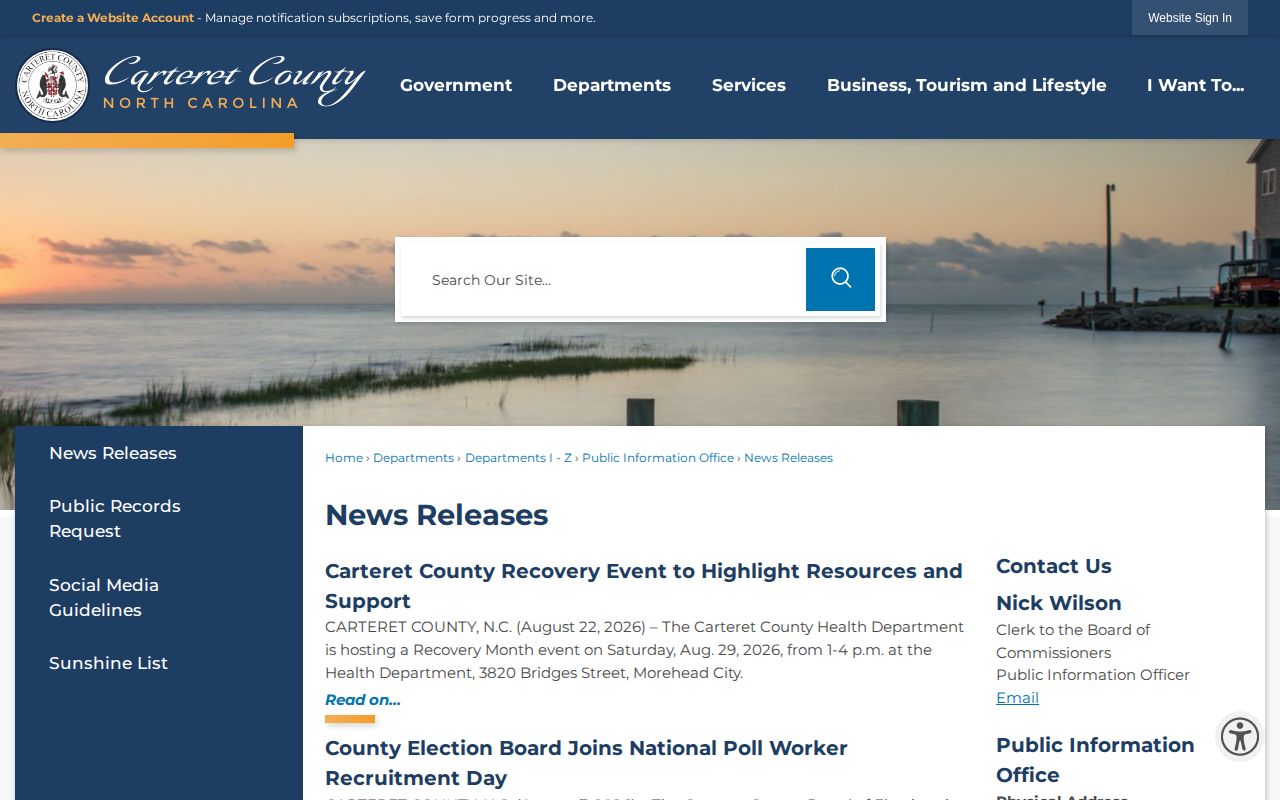
The Carteret County News Releases page is the official press-release route. The capture below illustrates a source page, not a gallery of people.
Releases from an agency add useful context. They just do not replace the roster, the Records Division, the clerk, or the court.
Carteret News Outlets at a Glance
Treat the table as a routing map. "Photos" signals that a story might carry an agency booking image, a wanted notice, a scene shot, or nothing at all. No outlet keeps a complete photo record.
| Outlet or source | Coverage | Photos? | Where to look |
|---|---|---|---|
| Sheriff News Releases | Official incident and public-information announcements | Story-specific | County releases |
| WITN | Regional crime and Carteret stories | Possible agency or wanted photo | Crime section |
| WCTI | Eastern North Carolina local news | Story-specific | Local section |
| WNCT | Regional Carteret crime stories | Article-dependent | Crime route, verify current category |
| Carolina Coast Online / News-Times | Local county newspaper coverage | Article-dependent | News-Times section |
| DigitalNC archive | Historical newspaper issues | Editorial images may appear | Carteret collection |
| County-local aggregator pages | Unofficial copied or archived booking pages | May display copied photos | BustedNewspaper, RecentlyBooked, Mugshots.com, Arrests.org, and Mugshots.Zone are secondary and may be stale or incomplete. |
A caution flag goes on those aggregator names. None are official Carteret sources. None can establish custody. Rank the Sheriff, the police agency, the clerk, and the court ahead of them every time. Correction policies at private publishers shift, too. The originating office is always the safer first stop.
How News Stories Get Booking Photos
Where does a news photo come from? Usually an agency release. Sometimes it arrives another way: a direct press request, a public-record response, a wanted notice, or an image supplied with a story. North Carolina law frames the rules. Chapter 132 covers public records, and N.C.G.S. §15A-502 addresses identification-photo authority. Neither one promises a booking photo in every story or on a live roster. Agencies can withhold protected material as well. That includes juvenile, medical, victim, sealed, expunged, and investigative records.
Carteret's Records Division keeps booking prints. It takes mugshot requests directly. No photo with the story? Ask the agency that holds the record. Arrests by Morehead City, Beaufort, or Newport police add a wrinkle. The city agency may hold the incident report while CCDC holds the county booking layer. Request each piece separately, and never assume the outlet has the original.
A news photo can linger in an archive long after a person leaves custody. The roster shifts without any article being touched. WITN, WCTI, WNCT, and the News-Times all update or pull stories under their own editorial rules.
A story can name an agency or a hearing without carrying the document behind it. Save the article date. Then confirm the event with the agency, CCDC, Records, or the clerk before you repeat it.
The agency named in an article often tells you more than the photo does. A Sheriff release points toward county custody. A municipal story from Morehead City, Beaufort, or Newport may start with a city report. Keep those paths separate when you request a correction or chase a later court result.
Note: A published photograph shows what an outlet selected for one story; it does not prove that Carteret maintains a public photo feed.
From a Story to the Record
A Carteret story gives you a name or an agency. Work backward from there, stage by stage. The county-wide roster and booking guide lays out the current custody path and the Records Division route.
- Save the story date, name spelling, agency, alleged charge, and any case number. Do not assume the headline is the final legal description.
- Check the CCDC portal for current county custody. Its days field can narrow a recent search, but the county does not promise a real-time feed or public photo display.
- Contact the arresting police agency or Sheriff’s Records Division for the incident report, booking record, or booking print, if releasable.
- Use the NC court portal and Carteret Clerk of Court for court dates, filings, and disposition. A calendar entry is not a judgment.
- Read later court information before repeating the story. Charges can be reduced, dismissed, continued, diverted, or otherwise resolved.
From a Story to the Record A news piece or a mugshot only marks the booking stage. Want the legal outcome? The court disposition holds that answer, not the headline.
Morehead City, Beaufort, and Newport each run separate police channels. None has a verified continuous municipal mugshot feed. The city page for each town maps its own records route and the handoff to CCDC. County coverage is wider than any single city. A quiet news page never proves that nobody was booked.
Carteret’s Event-Driven News Pattern
Carteret County news follows a split pattern. Regional outlets write up notable incidents, naming people when a story warrants it. Official town sites, meanwhile, stay quiet on that front. Beaufort keeps a document library with the occasional arrest release plus police statistics. Newport offers aggregate totals at best. Morehead City runs a police department with a records request route, but no live arrest log. Mixing these sources into one roster of names would be a mistake.
County-level numbers deserve the same skepticism. Jail intake counts, average daily population, arrest targets, and police totals each measure something different. None of them reveal how many booking photos are public. For a question about a specific person, go straight to the agency involved, then the county portal, then Records, then the court.
Note: News cadence follows events and editorial judgment, not the Carteret jail’s custody changes or the court’s final disposition schedule.